





April 8, 2026
Planting the Vision
After learning of the sorry state of Jerusalem’s walls, Nehemiah responded with prayerful dependence, careful preparation, and quiet assessment before calling others to act. As Alistair Begg points out, his leadership combined trust in God’s sovereignty with practical wisdom and courage in the face of opposition. Through Nehemiah’s example, we’re reminded that God’s work advances through ordinary people who rely on Him, persevere through discouragement, and unite around a shared, God-given purpose.
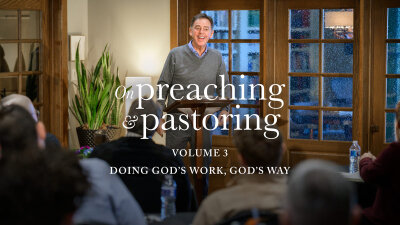
On Preaching and Pastoring, Volume 3
Doing God’s Work, God’s Way Nehemiah 2:9–20, Nehemiah 3:1–4:23, Nehemiah 13:1–31 Series • ID: 29023Sermon Transcript: Print
I want to just ramble for a little bit to set the context for this, but I think we should read the Bible before I ramble, because if I actually drop dead after the reading of the Bible, then at least you have the Bible as your last memory rather than some foolish rambling from me. So, Nehemiah, and let’s go to chapter 2—because that’s what we put on the sheet, I think, that we’re supposed to do—to verses 11 to the end. So, let me just read from verse 9:
“Then I came to the governors of the province Beyond the River and gave them the king’s letters. Now the king had sent with me officers of the army and horsemen. But when Sanballat the Horonite and Tobiah the Ammonite servant heard this, it displeased them greatly that someone had come to seek the welfare of the people of Israel.
“So I went to Jerusalem and was there three days. Then I arose in the night, I and a few men with me. And I told no one what my God had put into my heart to do for Jerusalem. There was no animal with me but the one on which I rode. I went out by night by the Valley Gate to the Dragon Spring and to the Dung Gate, and I inspected the walls of Jerusalem that were broken down and its gates that had been destroyed by fire. Then I went on to the Fountain Gate and to the King’s Pool, but there was no room for the animal that was under me to pass. Then I went up in the night by the valley and inspected the wall, and I turned back and entered by the Valley Gate, and so returned. And the officials did not know where I[’d] gone or what I was doing, and I had not yet told the Jews, the priests, the nobles, the officials, and the rest who were to do the work.
“Then I said to them, ‘You see the trouble we[’re] in, how Jerusalem lies in ruins with its gates burned. Come, let us build the wall of Jerusalem, that we may no longer suffer derision.’ And I told them of the hand of my God that had been upon me for good, and also of the words that the king had spoken to me. And they said, ‘Let us rise up and build.’ So they strengthened their hands for the good work. But when Sanballat the Horonite and Tobiah the Ammonite servant and Geshem the Arab heard of it, they jeered at us and despised us and said, ‘What is this thing … you are doing? Are you rebelling against the king?’ Then I replied to them, ‘The God of heaven will make us prosper, and we his servants will arise and build, but you have no portion or right or claim in Jerusalem.’”
Amen. Amen.
So, from there to some little bit of rambling.
I feel very confident in going pretty well directly to the eleventh verse of chapter 2. Because of the fact that we’re in each other’s company, I assume that you’re familiar with Nehemiah, that I don’t need to fill in a lot of the background. But it may not be just immediately fresh in our minds, and so you’ll forgive me if I try and take a moment or two to get to the eleventh verse.
The heading under which we’re doing this is “Planting the Vision.” And I want you to know that the idea of planting a vision is not something that I’m familiar with. When I came to this church years ago, there was one of the elders, and he was a very pragmatic fellow—very nice man but very pragmatic. And so he wanted me to go away and come back with my vision for the church. And he actually was more specific than that: I think he wanted a one-year vision and a five-year vision. And so I went away, and I thought about it for a long time, and I decided I didn’t even have any vision. And the only vision that I could come back with was from Revelation 7:[9], where John says, “And I saw a company that no one could number from every tribe and nation and language and people and tongue.”[1] And so I said, “I guess that is the overarching vision that we have as the people of God in the kingdom of God.” I don’t think it really pleased him very much. I think he thought it was a cop-out. I think he was of the impression that, you know, most pastors think they’re doing fine just because they don’t know what they’re doing. And he had me in that category—which I found very encouraging, I must say.
And I was heartened by the fact that when we turn to the pages of Scripture, although this is a vision that is planted, it is a vision that is planted by God, that is planted in the heart of a servant of God—that Nehemiah’s not the president, if you like, of the Bright Ideas Club. And it’s a dreadful pressure when people want to set us in that kind of framework in the hope that we ourselves are capable of engendering all of these kinds of things.
Ezra and Nehemiah, as you know, overlap with one another. When we studied these books in Old Testament Theology, we had to write an essay arguing either for the primacy of Ezra or the primacy of Nehemiah—which came first and so on. It was a fairly worthless exercise. And the fact of the matter is that Ezra and Nehemiah are actually different men. Ezra seems to be the one who appears in the middle of everything in Nehemiah—when we’re bringing out the Book,[2] that he is the one who is the man of the Word, if you like, more so than Nehemiah, who is the man of prayer.
And we know virtually nothing about Nehemiah. I find that always intriguing. He is, in the economy of God, strategic at this point in history, but we don’t have anything of his pedigree. He’s not introduced to us on the strength of what he’d done, where he’d been, his background, his technicalities, and so on. No, he’s just the servant of God. And Motyer says, “We may assume that Nehemiah grew up in Babylon with the exiled people, but was imbued with the spirit of Psalm 137.”[3] The opening of Psalm 137, remember: “We sat down … [we] wept.”[4] And the psalmist says, “O Lord, help me not to forget Jerusalem.”[5] And so Nehemiah is preoccupied with that.
I should say as well, on a personal note, that when I came to the church here in 1983, I did a series under the heading that we’ve used for this day today, and that is “Doing God’s Work, God’s Way.” I figured that maybe if we can figure out what that is, it will help us get off to a good start. And so it is that all these years later, we’re all still trying to do God’s work, God’s way.
And Jerusalem—the Jerusalem to which Nehemiah goes was in a sorry state, as you know. And the people had been carried off into exile. There had been the opportunity for a return. A small group had gone back, and yet Artaxerxes had put an end to that. And in the midst of all of that secondary desolation we have the appearing of Nehemiah.
We’re introduced to him in Susa, the capital of the Medo-Persian Empire—that’s where he is—approximately eight hundred or nine hundred miles via the Fertile Crescent from where he was to arriving in Jerusalem. So, my geography’s poor, but I would think it would be like setting out on a donkey from here to Colorado Springs—something like that—or going south some eight hundred miles to just south of Jacksonville or somewhere. So it’s a vast journey, and it is quite incredible.
The story unfolds in such a way that we are introduced to the kind of people that God chooses to use, the principles that God’s Word gives us to apply, and the persistence that is required if we’re going to actually see this through.
Reaction and Counteraction
Now, again—and I’ll leave you to fill in the background—but the reaction of Nehemiah to the word that comes to him from his brother Hanani is just very, very interesting: He “sat down,” and he “wept.”[6] Now, I just said that he was imbued with the spirit of Psalm 137. In Psalm 137, it’s the very same phraseology: “By the [rivers] of Babylon, … we sat down and wept”[7]—“because we had realized how far out of things we were and how far it was to get back to where God desired for us to be.” And now, as that news comes to him, he reacts in the same way: “I sat down, and [I] wept.” That was his reaction. But it was prayer that was his counteraction. His counteraction.
This morning, if you do Murray M’Cheyne, part of the reading was the Thirteenth Psalm. I’ve always liked the Thirteenth Psalm. You know, it begins, “How long will you forget me, O Lord? Forever? How long must I have sorrow in my heart every day?”[8] It’s usually a good Monday-morning Psalm for me. But it’s because in verses 5–6, although David’s circumstances have not changed, his perspective has changed. And so he says, “I will sing, I will rejoice in my salvation, and I will give you praise—not because verses 1–4 aren’t real but because you are who you are.”[9]
And so that’s exactly what we find with Nehemiah here. “The God of heaven.”[10] “The God of heaven.” That is the perspective that he begins with. He actually begins, when you look at his prayer—and we won’t go through his prayer—he begins by telling God about God: “O God, this is who you are!”[11] He doesn’t have to tell God in case God doesn’t know, but he is reminding himself of the vastness of the one to whom he comes. And what he does is he dwells on the divine nature.
And that phraseology, “the God of heaven,” is just representative of the character of God, not only because of the encouraging aspects of God’s love for us, his steadfast care for us, but because it reminds Nehemiah who God is and who he is. In other words, when we begin with the majesty and glory of God, then we get ourselves in a right kind of perspective.
It was one of the old presidents—not this president, for sure—but it was one of the old presidents who was sitting out on the White House balcony with a friend, and as the evening fell and as the sky was illuminated by the vastness of the starry host and by the moon, the president, sitting in silence with his friend, turns to him and says, “I think we feel small enough now to go to bed.” “The God of heaven”—that’s his beginning.
Now, you don’t expect, then, that, having made this great declaration about the majesty and power of God, that he will then be very honest and say in verse 2, “I was very much afraid.”[12] “I was very much afraid.” Now, I don’t know about you, but I find that fantastically encouraging. Because if he was afraid, that gives me justification for all the times that I’m afraid as well. And you know how he approaches the king, and he asks him for these various permissions and so on, and he is convinced because, again, of “the good hand of … God [who is] upon me.”[13]
Relaxation
So the setting is pretty straightforward. The inevitable opposition is about to come, but he arrives up there and, in verse 11 (I’ve made it to verse 11, which is encouraging for me at least): “So I went to Jerusalem”—obviously covering over a tremendous amount there. “So I went to Jerusalem and was there three days.”
Don’t skip that! Why would he tell us that? In fact, why do we have Old Testament narrative at all? Because we preach Christ, and because the narrative—the people God uses, and the plan that God unfolds—is all moving forward to the one who is to come.
So, he says, “I got there, and I backed off for three days.” Well, if you think about it, as I said, if the journey from Babylon to Jerusalem is as long as it is, if he was able to go direct route, he could have gone right across the desert in probably about five hundred miles. But by the time he gets there, after a long and tedious trek, he decides on some relaxation.
We preach Christ, and the narrative—the people God uses, and the plan that God unfolds—is all moving forward to the one who is to come.
Let’s just say a word about relaxation. It’s probable that this included the Sabbath for him, I would imagine, in the three days. The task ahead is huge. He’s already acknowledged the fearfulness and yet his dependence upon God. And he realizes, too, that he’s only going to be at his best when he’s had a good night’s sleep. You say, “Well, that doesn’t sound very spiritual at all.” Well, but if you remember when Elijah decided that he was the only person left in the kingdom, that the antidote to that was a large sixteen ounces of water and a couple of muffins. This is not exactly what you call a normal spiritual rescue—but in fact, it was.
Now, you may have come here today. It’s Wednesday. Maybe you’re tired. Can I just say a couple of things about my MO in relation to being tired? I’m not a fan of people who keep telling me they’re tired. I don’t know why they do that. We once had a youth pastor here who shall be nameless. It’s a long time ago; you could never find him. But he came from the South, and I never really met many from the South. And I used to say to him, “How are you this morning, X?” And he’d say, “I’m tired.” “I’m tired.” And I used to think, “You’re tired? What are you tired from doing? You don’t do hardly anything here.” I didn’t say that to him, but that was what my encouraging heart was thinking. I’m like, “You’re tired? You’re single. You’re tall. You got a couple of things to do.” Anyway, he got so tired, he eventually went to sleep, and that was the end of him, so…
When you’re tired—I made a note to myself… Incidentally, when we’re overtired, probably the people around us will get it faster than we do—particularly our wives. So, I made a note to myself: When I find myself tired like that… (And this is all under the heading of “He just stayed there for three days.” If you want a heading: relaxation.) Don’t make any important decisions. Don’t write any important letters or emails. Don’t launch new projects. Don’t quit. Don’t assess your spiritual life—or, for that matter, anybody else’s spiritual life. Hopefully today, in part, will be something of a respite. I hope so. But, of course, Sunday always comes. And so, it doesn’t matter; the closer we move to a Sunday, the more that lays on our heads and our hearts.
Anyway, so, verse 11: relaxation.
Motivation
On from there to, if you like, motivation. Motivation. What does he say? “I went to Jerusalem … [I] was there three days. … I arose in the night, I and a few men with me. And I told no one what … God had put [in] my heart to do for Jerusalem.” That’s the key, isn’t it? What God had put in his heart.
Very, very important, because those who observed him when he finally launches into his project, they might be quick to jump to their own conclusions: “Why has this fellow shown up here? Why have you decided to plant a church here?” You know, “What do you think you’re doing? Don’t you know that there are a number of things going on here? Do we really need another one?”—that kind of thing. They would say, “Who is Nehemiah? Is he an empire builder? Is he wanting to make a name for himself? Is that his plan?”
The fact is that that goes with the territory. “Why did you ever leave Scotland?” they used to say to me. “Scotland is in a dreadful state, apparently, from what we can tell, and you come over here to America. Who do you think you are? What do you think you’re doing over here? You can’t even speak the language properly. It’s ridiculous.”
This is not unique to Nehemiah. You think about it—think about it in relationship to Paul in 2 Corinthians. And I thought—I went to look for this, ’cause I thought, “I bet The Message does a good job of getting this over,” where Paul, he says to the Corinthians, he says, “I don’t care whether I’m judged by you or by any human court. My conscience is clear, but that doesn’t make me innocent.”[14] That’s sort of the ESV or the NIV.
This is J. B. Phillips: “You should look upon us,” writes Paul,
as ministers of Christ, as trustees of the secrets of God. And it is a prime requisite in a trustee that he should prove worthy of his trust. But, as a matter of fact, it [means] very little to me what you, or any man, thinks of me—I don’t even value my opinion of myself. For I might be quite ignorant of any fault in myself—but that doesn’t justify me before God. My only true judge is the Lord.
It’s pretty good.
In The Message:
Don’t imagine us leaders to be something we aren’t. We[’re] servants of Christ, not his masters. We[’re] guides into God’s most sublime secrets, not security guards posted to protect them. The requirements for a good guide are reliability and accurate knowledge. It matters very little to me what you think of me, even less where I rank in popular opinion. I don’t even rank myself. Comparisons in these matters are pointless. I’m not aware of anything that would disqualify me from being a good guide for you, but that doesn’t [matter] much. The Master makes that judgment.
You know, and what was it, John Knox? They said that he feared the face of God so much that he never feared the face of any man.[15]
And it’s a good point just to make sure that our heart is the very epicenter of what we’re doing. “God put it in his heart to do.” It’s a sad thing when you see… Some of you will watch the Premier League. That may be not 1 percent of you. But if you watch the Premier League at the moment, you know that Liverpool has gone into the most unbelievable slump. And they can still play football, they still have a good coach, they still know where the goal is, they still know how to defend, but for some reason, their heart’s not in it. Their heart’s not in it.
One of the saddest pictures is the picture of the disillusioned pastor who now knows what the task is, has the tools for the task, but his heart isn’t in it. And hopefully, what we do for one another today is strengthen each other’s hearts. It’s very unlikely that any of us are going to learn something that we never knew. I think it’s far more likely that we will be reminded together of things that we mustn’t ever forget.
Examination
So, he stops, he relaxes, his motivation springs from his heart, and then he goes into his reconnaissance mode, surveying the property. Essentially, what he’s doing: He knows what is before him, and he’s conducting a feasibility study. He knows there’s an opportunity. He wants to figure out just how feasible it really is.
And you will notice, as you have the text in front of you, that he does so quietly. He does so quietly. I think it’s very good, too, isn’t it, that we don’t have Nehemiah coming into Jerusalem, you know, on horseback with a big entourage, and somebody’s blowing the trumpet? “You’re all fine folks. It’s okay. I know you’ve had some problems, but Nehemiah is here!”—you know. “Here we go! Here we go.” Nehemiah wouldn’t like that. And so he points out that he didn’t do this in that way. He didn’t want a lot of snorting. He didn’t want a lot of neighing.
Round the corner from us, there are donkeys. And every so often, my wife will say, “Did you hear that?”
And I said, “No. Hear what?”
And she said, “Did you hear the donkeys?”
Well, I’m half deaf, so I can hardly hear what she said, let alone hear the donkeys. But when she pointed it out, they do make a devil of a racket. All right?
And so he says, “We’re not going to do that. I’m going to do it very carefully, quietly.” Ecclesiastes 3: There’s a time to be quiet.[16] He says, “This is a time to be quiet.”
Not only does he do it quietly, but he does it secretly. Secretly. In fact, I love verse 16 (I hope you do too): “I went up by night. The officials didn’t know where I had gone or what I was doing. And I hadn’t yet told the Jews, the priests, the nobles, the officials, and the rest who were going to be doing the work.” They didn’t know what was coming. No, no, no, no!
So, quietly, secretly, methodically. He actually tells us the way he did the circuit: by the King’s Pool. That’s the same place; that’s the Pool of Siloam. That’s where he was. The wall had toppled down, which prevented his progress. He’s not going to be able to stay on his foal or his donkey or whatever else it is. It forces him to dismount. Because what he’s actually doing is he’s building a picture. He’s getting a framework in his mind of what needs to happen, who needs to be involved. And he recognizes that he better get the thing clear in his own mind before he actually presents it to the people who are going to be involved in the process.
Exhortation
And so, if you like… And I just made these words up. What was the first one? Relaxation, motivation, examination. And then, if you want another one, let’s go to exhortation. Exhortation. “Then I said to them, ‘You see the trouble we[’re] in[?]’”
And it would seem that they didn’t. They didn’t. It took somebody like Nehemiah, in whose heart God had planted a vision, to go into the environment to which God was sending him and to look at it in such a way that he saw things that other people missed, that…
If you remember in My Fair Lady… What a segue that is! But if you remember My Fair Lady, where—“Just you wait, [Henry Higgins]; just you wait [Higgins]”[17]—and he gives all the business to that girl and so on. And she gets fed up with him, and she sings that song, you know: “There’ll be sun in the sky without you,”[18] and so on. And he’s “Good! Fine! Get out of here!” And then, in reflection, he sings, “I’ve grown accustomed to her face, her ins, her outs, her ups, her downs. I’ve grown accustomed to her face.”[19]
What had happened to the people in Jerusalem was that they had grown accustomed to disgrace. To disgrace. It was a shambles! And the issue was not the gates or the walls. It was what the gates and the walls represented. It represented the fact that the glory of the God of heaven was being dragged in the dust of a Judean hillside. And the enemies looked on at the poverty of this very situation and the people who were living in it—those who had gone back and who were just there post the Ezra visit, if you like, and some of their children that had grown. The walls were broken down! They probably said, “Well, this is a lovely place to plant some flowers. We’ll put some flowers on the wall. We’ll accommodate ourselves to the situation. There were great days before, but these are our days now. So, hey!” So it takes somebody to come and say, “Do you see the trouble we’re in? Do you recognize this?” he says. “Do you actually see how Jerusalem lies in ruins, and its gates are burned with fire?” “Come”—exhortation—“let[’s] build the wall of Jerusalem, that we may no longer suffer derision.”
Well, I don’t know how many times we’ve had occasion to present something in the course of pastoral ministry—a new discipleship program or whatever it might be—and within relatively short order, we run up against the usual responses.
“Come on! Let’s do this!”
“Oh, no, pastor! This is out of our league. This is not the kind of thing we can do.”
Or, “We tried this before. The previous pastor tried this. It didn’t work then, and it won’t work now.”
Or, “Hey, we recognize you’re kind of stirred up about things, but I’m going to tell you,… And I’ve talked to quite a number of people”—which means, “I spoke to myself and my wife”—“I’ve spoken to quite a number of people, and nobody’s excited. Nobody’s excited.”
If God hadn’t put it in his heart to be where he was and to do what God had desired for him to do, then I assume that he would have made the long trek back to Babylon. If he’s going to take his cues from the people that he is called to lead, then he’s going to be led rather than leading. He’s going to have to determine whether he wants to lead or whether he wants to be liked. Because if all he wants to be is liked, then he can accommodate himself to the lowest common denominator that is present within the framework to which he’s come. And that, of course, is true for us in our context.
Information
So he told them two things—verse 18. So I just wrote down the word information. (I don’t even know if these things work, but anyway.) Information: “And so I told them two things.”
Incidentally, let’s make sure we don’t miss this: that his approach from the very beginning—and you’ll notice it in his prayer in the opening verses of chapter 1—he is speaking in terms of the “we,” the “our,” the “us.” His word is not “You’ve got a problem” but “We’ve got a project.” “We’ve got a project.” And so he explains that both the authority of heaven and a civil authority of earth is engaged in this rebuilding project—that God has actually moved in the heart of the king. You see that in the text: “I told them of the hand of my God that had been upon me for good, and also of the words that the king had spoken to me.”
So both things would be true. They might have said to him, “Well, that’s all very good, all the God talk. But what about the practicalities of it? What are we dealing with here? We’ve got the housing authority to deal with. We’ve got the planning permission to deal with. We’ve got all the other stuff to deal with. It’s all very well, you saying we’re going to pray about it, Pastor. But what about that?” Well, he’d already done that. He’d already done his homework.
Nehemiah’s word is not ‘You’ve got a problem’ but ‘We’ve got a project.’
And you see back in the prayer: “We[’ve] acted very corruptly against you,” he prays.
[We] have[n’t] kept the commandments, the statutes, … the rules that you commanded your servant …. Remember the word that you commanded your servant Moses, saying, “If you[’re] unfaithful, I will scatter you among the peoples, but if you return to me and keep my commandments and do them, though your outcasts are in the uttermost parts of heaven, from there I will gather them … to the place that I have chosen, to make my name dwell there.”[20]
And, of course, when he spoke to the king, he did so nicely: “And I said to the king…”[21] Incidentally, it was quite a job, the cupbearer. Right? I mean, that’s a high-risk job. ’Cause you’ve got to go first. And if you go down, the king goes, “Well, I’m glad I had that guy!” And so you always want to be on your best behavior when you’re serving the king.
And, as you know, when you backtrack, he goes into the presence of the king, and the king says, “You’re not up to your usual standard this morning, Nehemiah. You seem to be somewhat sad. What are you sad about?”[22] The king wanted to make sure that he wasn’t feeling sad because he spiked his drink, for whatever reason. And so: “I [told] the king, ‘If it pleases the king, and if your servant has found favor in your sight, that you send me to Judah,’”[23] and so on.
And the way in which he approaches that is both respectful, and it’s masterful. And he wants them to understand that the authority of heaven is such that the subject of earth is under the jurisdiction of God—that God is sovereign over the heart of the king.[24] Over the heart of the king! I’m not sure that we’re prepared to really believe that at the moment. But that’s what he tells them.
And so the response in the second half of the verse, if you like, is to make application: “I told them of the hand of … God that [was] upon me for good, … also of the words … the king had spoken to me. And they said”—they said—“‘Let us rise up and build.’” There were designated roles that they were going to fulfill. There were tasks that each of them were going to have to play. There was plenty of rubble for them to clear. And they were ready to launch into the fray.
Opposition
And then that leads immediately to the word of opposition: “‘Let us rise up and build.’ So they strengthened their hands for the good work. But when Sanballat the Horonite and Tobiah the Ammonite servant and Geshem the Arab…” This is the unholy trinity that runs throughout this passage.
There’s another character introduced in—we’ll never get to chapter 6, you’ll be relieved to know—but in chapter 6, when they create that letter. And so they sent this letter, and they said, you know, “This is the word,” and “Gashmu”[25]—Gashmu agrees with this. Nobody, including Nehemiah, got the foggiest idea who Gashmu was. Again, it’s like those letters that you get: “And I’m writing to you on behalf of a number of people, and also Mr. Gashmu.” And you’re like, “Gashmu? I don’t know who Gashmu is. I don’t know what it is.”
But the opposition is clear. They jeered. They mocked. They despised. How is he going to face discouragement? How is he going to face sarcasm? How is he going to overcome this when the thing hasn’t even started yet? When you haven’t even begun?
I remember a long time ago, in those early days—if I had had a return ticket instead of a one-way ticket, there was sufficient opposition in those early days to get myself, my wife, and my three kids back on a plane, use the second part of the ticket, and go. “Why didn’t you go?” Because of what God had put in my heart to do. He didn’t say, “You put it in your heart, and it’s going to be easy,” or “You put it in your heart, and it will be tranquil.” “You put it in your heart…” No. We’ve got to expect this, don’t we?
I was thinking this morning that if we were going to sing a hymn, one of the hymns we could have begun with is
The Church’s one foundation
Is Jesus Christ [our] Lord;
[It is the] new creation
By [Spirit] and the Word.
From heaven he came and sought her
To be his holy bride;
With his own blood he bought her,
And for her life he died.Elect from every nation,
Yet one o’er all the earth,
[Our] charter of salvation:
One Lord, one faith, one birth.
One holy name she blesses,
Partakes one holy food,
And to one [goal] she presses,
With every grace endued.
But then it goes—and I like the fact that it’s there—“’Mid toil, and tribulation, and tumult…”[26] It’s a good word.
Maybe you’re here, and you’re just glad to be in Ohio to get out of the tumultuous circumstances that you’ve left behind. You didn’t use the word, but now that I’m using it, you say, “That’s what it is! It is tumult. It’s tumultuous. I can’t spell it, but it’s a good word.”
’Mid toil and tribulation
And tumult of [our] war,
[We wait] the consummation
Of peace forevermore,
[When] with the vision glorious
[Our] longing eyes are blessed,
And [then the] church victorious
[Will] be the church at rest.
But it’s not finished. It’s not finished.
And, you know, when we think about what Paul says in Romans 15—he says that all the things were written in the past so that through endurance and the encouragement of the Scriptures we might have hope.[27] That we might have hope. We get to the average midweek in an average period of time in the midst of doing the work of God, and sometimes we say to ourselves, “This is almost hopeless to me. This is hopeless. What hope is there?” Well, our hope is anchored in the past, because Jesus rose; our hope is guaranteed in the present, ’cause Jesus lives; and our hope is assured for the future, ’cause Jesus is coming.
And in the funny words of a movie that hardly anybody has seen and shouldn’t go to look for—it’s something about all these people from Britain that decide to go to India to live in an old people’s nursing home, which would be the best place ever. I forget what it’s called. So they all ship out from the UK, and they get on the plane, and they go to India, and they get there. And it’s not what they expected. And one after another goes to the front desk, and the poor little Indian guy who’s responsible for the place, he has to field all their stuff: “Well, the heating is not working in our room.” “The tap on the left side is not functioning.” “The blinds don’t close.” It just goes on and on and on. And he always says the exact same thing to them: He says, “I must tell you: It will be all right in the end. And if it is not all right, it is not the end.”
This is the beginning. This is the beginning! And it is the onslaught of the Evil One against the work of the true and living God. This is the great battle, right? This is the heel and the head thing here, back in Genesis.[28] That’s what’s unfolding all the way through.
And so, he says… The key is in that phrase “the God of heaven.” “The God of heaven.” “I told them of the hand of my God that had been upon me for good, and also of the words that the king had spoken to me. And they said, ‘Let us rise up and build.’” “But when they heard, this is what they had to say.”
“I lift my eyes to the hills”—Psalm 121. “Where does my help come from?”[29] I can imagine Nehemiah saying to himself, “Golly! This seemed like a great idea. And now I’m here, and it doesn’t seem like this was how it was going to be. This is kind of like, ‘Through many dangers, toils, and snares…’”[30] Exactly!
So what do I have to say to myself? Well, I remind myself that “as the mountains are round about Jerusalem, so the Lord is round about his people from [this time forth and] even for ever [more].”[31] I say to myself, “Where does my help come from?” And I say, “My help comes from the Lord, the Maker of heaven and earth.”[32]
And so he says, “You fellows should know, you chaps, that here’s my reply: The God of heaven will make us prosper.” He is the only one who makes us prosper. That’s why Paul, when he writes to Timothy, he says, “[Hey,] be strengthened [in] the grace that is in Christ Jesus.”[33] “We look to God, and we his servants—that’s who we are—we his servants will arise and build. But you should know that you have no portion in Jerusalem.” The people of God stand in distinct contrast to the people of the world. And it is in the awareness of that that we serve God and we engage in things for God.
Vision
And I think—coming full circle to the question that the elder gave to me, you know—in fairness to him, he wanted to make sure that I wasn’t just sitting around twiddling my thumbs, that I wasn’t going keep saying, “I’m tired. I’m tired.” No! He wanted to know if there was something that I was trusting God for that was so large and so incredible that it could not be achieved apart from God’s divine provision. Well, the answer to that, of course, is yes! And not least of all, the radical transformation brought about by the work of the Spirit of God through the Word of God in the lives of the people of God—so that instead of our role being sort of a hortatory role, like, “Come on, folks, let’s get going here!” it’s a good day when we realize we’ve got to limit the amount of that stuff we do. What strengthens their hands for the task is the awareness that together, we are on the Lord’s side, and that we are relying on his grace to fulfill his purposes.
Now, I don’t want to keep going on. I think I’d like to stop. But I’ll just say a couple of things about the notion of seeing a vision established with people who don’t get the vision.
What strengthens our hands for the task is the awareness that together, we are on the Lord’s side, and that we are relying on his grace to fulfill his purposes.
First of all, if it’s our vision, they shouldn’t get it anyway. I mean, what does it really matter?
But I’m sure you’ve found this to be true: that people instinctively resist change. They just resist change. If you take the entire population, there’s about 2 percent of people… Let’s say you’ve got just a small group of church leaders, and you present something to them. So you might just get one—one out of ten—who says to you afterwards, “Pastor, I think that’s terrific.” If you got that one, that’s a good start, ’cause often you don’t get any of them.
Only about 2 percent of the population get onto something quickly. Ten percent are the kind of people who are saying, “Well, yeah, yeah, yeah. We can get with that.” Sixty percent are, in my experience, fence-sitters. They’re committed, really, to the status quo: “It’s been going pretty well. Not as good as we thought, but it’s better, so don’t rock the boat.” Twenty percent of the people are the last folks to get on board, because they always see the pitfalls—or, if you want to put it in positive terms, they want to be alert to the dangers, so they want to safeguard. There’s nothing wrong with that. And then there’s a small percentage who are just bringing up the rear end, always. And we have to love them. And my experience is that if they didn’t initiate it, they usually don’t like it: “If it wasn’t my idea, it’s not a good idea.”
Well, you think about Nehemiah here: He did it quietly. He did it secretly. He did it methodically. He wasn’t there to tell him about his idea. When he lays it on them, he says, “This is what God has put in my heart to do. And here’s the evidence that God’s hand is on that, because look at these letters I can show you from the king.” And people say they don’t want to change anything because it’s just disruptive to their routine. “We want to change the service time to X.” “No, we can’t do that! I always stop at the coffee shop at the such-and-such, and if you move it to then, I won’t be able to be there.” Oh, there’s real kingdom problem! Thank you for mentioning that. Thanks. Yeah.
“Well, we’re going to do it on Thursday evenings now.” “Nothing happens on Thursday evenings. We’re afraid of it. It’s unknown. Well, I wouldn’t like to launch into something like that. I’m afraid that it won’t work.” Or they say no because whatever potential reward is there, it seems absolutely inadequate compared to the amount of effort that’s involved.
Sometimes they react because they lack respect for our leadership. They lack respect for our leadership. We might not know that, but that might actually be it. Sometimes they react because they have a different agenda entirely—not necessarily their own agenda, but an agenda from somewhere else. Sometimes they react in that way because they are living in the past rather than learning from the past.
Do you see the trouble the twenty-first-century church is in? A nation that has the Ten Commandments around the roof of the Supreme Court building; that has the Scriptures emblazoned into the main railway station in Washington, DC; that has a heritage, at least, of God-fearing; and yet, here’s the predicament—and in the middle of that, the church of Jesus Christ, “’mid toil and tribulation and tumult of her war[s].” And “for such a time as this,”[34] you and we have been brought to the kingdom, have been given the unbelievable privilege of having any part in the unfolding drama of God’s redemptive purposes—and that no matter how it seems, “the Lord God omnipotent reign[s].”[35] It doesn’t always seem so, but it always is so. And when he puts it in our hearts, then fearfully, prayerfully, certainly not isolatedly, we’re going to go forward and see what God has in store.
Well, just a brief prayer. That’s enough.
Father, thank you that your Word is a lamp to our feet, a light to our path.[36] We pray that as we ponder these things in looking into Nehemiah today, that you will save us from error, that you will guard us and keep us in the pathway of your appointing.
We thank you for the privilege and for this time. Bless the casual conversations that unfold as the day goes by, which may actually prove to be far more significant than anything else that we do.
We look from ourselves to you, Father. You love us with an everlasting love.[37] And if we, being earthly, know how to give good gifts to our children, how much more will you, our heavenly Father, give good things—give the Holy Spirit—to those that ask you![38] Come, Lord, and meet us, we pray. In Christ’s name. Amen.[1] Revelation 7:9 (paraphrased).
[2] See Nehemiah 8:1.
[3] Alec Motyer, The Story of the Old Testament: Men with a Message, ed. John Stott (Grand Rapids: Baker, 2001), 174.
[4] Psalm 137:1 (ESV).
[5] Psalm 137:5–6 (paraphrased).
[6] Nehemiah 1:4 (ESV).
[7] Psalm 137:1 (ESV).
[8] Psalm 13:1–2 (paraphrased).
[9] Psalm 13:5–6 (paraphrased).
[10] Nehemiah 1:4 (ESV).
[11] Nehemiah 1:5 (paraphrased).
[12] Nehemiah 2:2 (ESV).
[13] Nehemiah 2:8 (ESV).
[14] 1 Corinthians 4:3–4 (paraphrased).
[15] James Douglas, quoted in W. Stanford Reid, Trumpeter of God: A Biography of John Knox (New York: Charles Scribner’s Sons, 1974), 290. Paraphrased.
[16] See Ecclesiastes 3:7.
[17] Alan Jay Lerner, “Just You Wait” (1956).
[18] Alan Jay Lerner, “Without You” (1956). Lyrics lightly altered.
[19] Alan Jay Lerner, “I’ve Grown Accustomed to Her Face” (1956). Lyrics lightly altered.
[20] Nehemiah 1:7–9 (ESV).
[21] Nehemiah 2:5, 7 (ESV). See also Nehemiah 2:3.
[22] Nehemiah 2:2 (paraphrased).
[23] Nehemiah 2:5 (ESV).
[24] See Proverbs 21:1.
[25] Nehemiah 6:6 (KJV).
[26] Samuel John Stone, “The Church’s One Foundation” (1866).
[27] See Romans 15:4.
[28] See Genesis 3:15.
[29] Psalm 121:1 (paraphrased).
[30] John Newton, “Amazing Grace” (1779).
[31] Psalm 125:2 (KJV).
[32] Psalm 121:2 (NIV).
[33] 2 Timothy 2:1 (ESV).
[34] Esther 4:14 (ESV).
[35] Revelation 19:6 (KJV).
[36] See Psalm 119:105.
[37] See Jeremiah 31:3.
[38] See Matthew 7:11; Luke 11:13.
Copyright © 2026, Alistair Begg. Used by permission. All rights reserved.
Unless otherwise indicated, all Scripture quotations for sermons preached on or after November 6, 2011 are taken from The ESV® Bible (The Holy Bible, English Standard Version®), copyright © 2001 by Crossway, a publishing ministry of Good News Publishers. Used by permission. All rights reserved.
For sermons preached before November 6, 2011, unless otherwise indicated, all Scripture quotations are taken from The Holy Bible, New International Version® (NIV®), copyright © 1973 1978 1984 by Biblica, Inc.TM Used by permission. All rights reserved worldwide.