






Oct. 8, 2025
Practice, Progress, and Persistence
In a church context that held great potential for apostasy, Timothy faced the task of leading through the example of his lifestyle and work. Faithful ministry, Paul explained to him, flows from godly character—speech, conduct, love, faith, and purity—and from wholehearted devotion to Scripture, exhortation, and teaching. Alistair Begg considers Paul’s guidance to Timothy, which can help today’s pastors, too, as they seek to watch themselves and their doctrine closely and see themselves and their hearers saved.
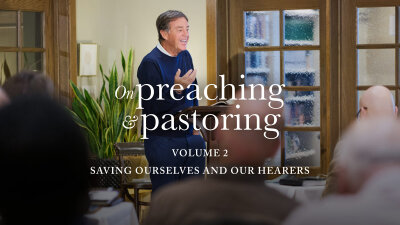
On Preaching and Pastoring, Volume 2
Saving Ourselves and Our Hearers 1 Timothy 4:1–16 Series • ID: 29022Sermon Transcript: Print
Well, from verse 11 to 16:
“Command and teach these things. Let no one despise you for your youth, but set the believers an example in speech, in conduct, in love, in faith, in purity. Until I come, devote yourself to the public reading of Scripture, to exhortation, to teaching. Do not neglect the gift you have, which was given you by prophecy when the council of elders laid their hands on you. Practice these things, immerse yourself in them, so that all may see your progress. Keep a close watch on yourself and on the teaching. Persist in this, for by so doing you will save both yourself and your hearers.”
Well, Father, we thank you for your continued gracious presence by the Holy Spirit among us in the events of the day. You assembled us not in a haphazard way but purposefully—that you have plans and purposes for us. You have good deeds foreordained for us to do.[1] And we offer ourselves to you as we come to the formal end of our time together, and we pray that we might always be a help and never a hindrance to one another as we seek to follow Christ, in whose name we pray. Amen.
Well, I think it’s fairly straightforward to say that if someone had asked Timothy if he could summarize the exhortation that was coming to him here from Paul in this fourth chapter—indeed, through the whole letter, perhaps—he would have said, “Well, I would answer by repeating verse 16: ‘Keep a close watch on yourself and on the teaching.’” He said, “I hear this sounding out clearly from the apostle’s pen.” Or, in J. B. Phillips’s paraphrase: “Keep a critical eye both upon your own life and [in] the teaching you give.” It’s a good word, isn’t it? “A critical eye … [on] your own life,” not a critical eye on the person up the street’s life. That’s not your problem or mine. In the NIV: “Watch your life and doctrine closely.”
Now, we began by noticing that the context in which this was taking place was one of the potential for apostasy. We also acknowledged that the letter is a personal letter—it is written to Timothy—but that it would also have a public reading. And so, in learning what Paul expects of Timothy, the congregations who were in the hearing of this material were also learning what to expect of their pastor.
I always find it one of the very difficult things to do. I felt very vulnerable when going through material like this in front of the congregation, because there is nowhere to hide. They know who you are—especially if you’ve been there for any length of time—and so on. And when you read these passages, they learn what it is legitimate for them to expect of their pastor. So if it’s challenging to read, as it were, in the privacy of our own home, it’s actually even more challenging to read it out in the public forum of the church.
Timothy’s Character
And Paul is aware of the challenge Timothy faces in fulfilling this. And he is to “command and teach these things.” It’s a very straightforward sentence, isn’t it? This exhortation actually comes eight times in the course of this letter. And what is he supposed to be conveying? Well, if you like, he has been charged… And some of you—we haven’t spoken about this—but some of you were doubtless in the military, and in the military, you were familiar with being given your standing orders. And the standing orders are “a military order outlining [overruling] that is retained irrespective of changing conditions.”[2] “A military order [overruling]…” Nuh-uh. I can’t read my own writing. It’s “a military order … that is retained”—whatever that word was—“irrespective of changing conditions.” (Incidentally, I’m violating my own material here. If you had prepared properly, you would know what that word was, and you would have fixed it. But it’s easy to tell others what to do. It’s much harder to do it yourself.)
Now, from the outset of the letter, he sounded out the note. To the question that my Scottish brother raised (What do we do in terms of confrontation and so on?), verse 3 of chapter 1: “As I urged you when I was going to Macedonia, remain at Ephesus so that you may charge certain persons not to teach any different doctrine, nor to devote themselves to myths and endless genealogies,” and so on—to be prepared as a young pastor to say, “You mustn’t believe that,” and, as a young pastor, to say, “And you must believe this.” That’s what he’s actually urging him to. And he recognizes the challenge that comes to him as a younger man.
Now, it’s speculation, but the chances are that Timothy may have been in his thirties, maybe even approaching forty. So we shouldn’t imagine that he’s a teenager like some of the disciples. But youthfulness brings its own challenges. A young minister is often prone to try to attain by one jump and to jump to the height that others have reached by a long series of jumps over a long period of time.[3] When we’re young, we’re impatient. We overestimate what we can accomplish in a year; we underestimate what we can accomplish in five years. We also have predilections that are part and parcel of youthfulness—the desire for power, the desire for possessions, the desire for prestige, the longing to fulfill our passions, and so on. And so, Paul understands all of this and more besides, and he wants it to be absolutely clear that Timothy needs to, if we might say, get ahold of himself.
The danger is, when you’re young, to try and cover for your youthfulness. (I say this, to my shame, really.) The temptation is to become bossy, perhaps; or to become very hortatory, constantly saying, “Come on! Come on!” and urging people; or to become authoritarian; or to try and make emphasis by dint of personality or by our use of volume or whatever it might be. All of these things we need to guard against always, because that’s not why we’re there. “Timothy, this is what you are to do: Command and teach these things, and don’t let people look down on you because you’re young.”
I was very young when I was ordained to the gospel ministry in 1976. If I was born in ’52, that means I was twenty-four. And I didn’t look very old at twenty-four. In fact, I didn’t even look twenty-four. And it was not something that was immediately appealing to anybody at all. I remember on one occasion in the early days, Derek Prime sent me to a hospital to visit a lady who was the wife of a doctor, a prominent heart surgeon in Glasgow called Philip Caves who tragically died of a heart attack himself after playing squash at the age of thirty-nine. Anyway, that’s just an aside. But so, I didn’t know him or his wife, but I was sent to visit. And when I got to the hospital, in the ward, she was asleep—asleep in the bed. So I just sat on the end of the bed. And she came to, and she saw me, and she said, “Who are you!” And I said, “Well, I’m the assistant to the pastor.” And she said, “But you’re a boy!” “But you’re a boy!” And I felt like saying, “Yeah. Yeah, yeah.” My first funeral—and I wore a clerical collar (I had to; that was the rule!)—when I walked out in that crematorium, I mean, people thought it was Saturday Night Live. “This cannot be the thing!”
So, I’m very susceptible to the idea of having people look down on me because of my youth. What he’s saying is “Don’t have them look down on you because you’re just young. Have them look up to you because you’re an example to them.” That’s what he’s actually saying. “People won’t despise your youthfulness, Timothy, if you give them an example to admire and to follow.”
So, the answer to our youthfulness is not saying, “Oh, no, I’m much older than you think, and I’m much”—and so on. No, no. “No, just make sure that you train yourself for godliness. And let me tell you where you should concentrate.”
Number one: “speech.” “Speech.” Makes perfect sense. You’re going to be a preacher, a teacher. You’re going to use your mouth. Make sure, then, that your speech is true, it’s kind, it’s purposefully helpful.
Remember that we used to say at school—at least in Scotland—“Sticks and stones will break your bones, but names will never hurt you.” Rubbish! Rubbish! You can recover from sticks and stones, but words—words have tremendous power. And words fitly spoken are like apples of gold in, you know, frames of silver.[4] But words that come from a tongue… James mentions it again, doesn’t he? Because your tongue, he says, it’s a deadly thing! It’s full of “restless evil.”[5] And it is the kind of thing that can do tremendous damage.
It is an irony, isn’t it—more than that—that when Isaiah is confronted in a dramatic way by the holiness of God… He is the prophet of God, set apart to the privilege of proclaiming the good news of God and calling people to account. And when God confronts him, what does he say? “I am a man of unclean lips”[6]—that the mechanism that God has raised up for usefulness becomes the real temptation to use it in a way that is unpalatable.
When all that we say
In a single day,
With never a word left out,
Were printed each night
In clear black and white,
It would make strange reading, no doubt.And then just suppose,
Ere our eyes should close,
We must read the whole record through.
Then wouldn’t we sigh,
And wouldn’t we try
A great deal less talking to do?And I more than half think
That many a kink
Would be smoother in life’s tangled thread,
If all that I say
In a single day
Were to be left forever unsaid.
You remember Wesley’s thing? “Every day, do all the good you can, to all the people you can, with all the means you have,” and so on. It’s so easy to start out in a morning like that and to discover that you haven’t made it to eleven o’clock, and you are already in difficulty. In the area of greatest gift, we’re confronted with the arena of the greatest potential for failure—“speech.”
“Conduct,” or behavior. The false teachers were into conduct and into behavior. They had their own regulations. We saw that in verse 3. “Your conduct,” says Paul to Timothy, “is to become like the Lord Jesus.” Because, after all, remember, Paul writes in Romans, and he says that the eternal purpose of God is that those whom he has predestined and called, it is in order that we might be conformed to the image of the Lord Jesus.[7] When he writes to the second Corinthians, he says, “And we are being transformed into his likeness.”[8] And when John writes in 1 John 3, he says, “And when we see him, then we will be like him.”[9] But we’re not quite like him yet. And some of us need to just check in with headquarters on this one.
The Father’s desire for every one of us, irrespective of gifting, location, geography, age, anything—it’s the same deal. He’s doing the exact same with every single one of us: committed to making us like his Son. That’s what he’s trying to do. Actually, that’s what he’s doing. He’s not trying. We might be trying. In fact, we’re very trying.
So the Father’s desire and the Father’s design is that: “speech,” “conduct.” Very obvious in public life, right? Because people can hear what you say. They can see how you drive your car. You know, there’s nowhere to hide on that. But what about the next section: “love,” “faith,” “purity”? Well, we could camp on any one of these, but we’re not here for the rest of the day.
He comes to this again, doesn’t he? Particularly the last of these. In fact, chapter 5: “Do[n’t] rebuke an older man but encourage him as you would a father, younger men [treat them] as brothers, older women as mothers, younger women as sisters, in all purity.”[10] He comes back to it again, still in chapter 5: He says, “Do[n’t] be hasty in the laying on of hands, nor take part in the sins of others; keep yourself pure.”[11] “Pure.” Purity.
The Father’s doing the exact same with every single one of us: making us like his Son.
Here’s a quote—I don’t know from whom, but I have it in my notes: “How many false and failing ministers have misused secluded pastoral situations to embark on sexual adventures to the shipwreck of their ministries and to the shame of biblical Christianity?”
Well, of course, we don’t want to pause unduly on this, but we need to take it to heart. You know, when you’re young, you imagine that one day you will be old. If you live long enough, you will be old. You can be, like me, in your seventies. And if you’re young, you may think, as I thought when I was the age you are, “It must be great! You get to seventy, and all that stuff—you know, the passions of youth, power, possessions, all these things—they’ll all be in the background.” Not for a moment. Not for a moment. No. The Westminster Confession is helpful when it says the Christian is engaged in “a continual and irreconcilable war.”[12] “A continual and irreconcilable war.” It is a war that has been won in Christ, but it is a war that we are waging all day, every day. And let the person who thinks he stands take heed lest he falls.[13]
Temptation is no respecter of style. The disasters in the years of my life have been disasters amongst some flamboyant people and some of the most unlikely people that you would ever imagine: some of the stiffest, starchy, old Presbyterian types who took their own life when they discovered that the community had discovered their multiple adulteries over a long period of time—while they were some of the most effective preachers and conference speakers in the entire Western world. We are naive at best if we fiddle with this.
What is the antidote to it? Well, the antidote to it is, first of all, the wife. That really helps. And that’s why God put the marriage thing together. And that’s why it’s virtually impossible to deal with Roman Catholicism without acknowledging what a manifold disaster that has been. And we’ll leave that aside for now. But Charles Bridges—if you remember old Charles Bridges (not Jerry Bridges; Charles Bridges)—Charles Bridges says that “tender, well-regulated, domestic affection is the best defence against the vagrant desires of carnal passions.”[14] It takes a Puritan to come out with that, but it’s very good.
So, I was speaking at a conference, and somebody asked a question about “What about you go to the conference, and you got here, you stay in the hotel, and you do the thing, and everything else?” I said, “Well, this is what Bridges said. He said that the best antidote to the kind of stupidity you’re talking about is ‘tender, well-regulated, domestic affection.’ And as soon as I get finished with this conference, then I’m going home for some ‘tender, well-regulated, domestic affection.’” And that’s the answer. That is the answer. Half of the situations that have emerged are twofold: one, because husbands do not fulfill the responsibility that God has entrusted them, and they deal with wives along the way; and then you add to that pride. And as soon as the pride thing takes over, it’s a slow train coming.
I mentioned earlier the trilogy about Cicero. And one of the great illustrations of this in that book… (Incidentally, these little Moleskine things are—they’re both a delight and a challenge, ’cause I can never find anything in them.) But Crassus, who is an opponent of Cicero, knows that if he can get Cicero to succumb to his seductive ideas, he will gain triumph over him. And so now, remember, it is the slave, Tiro, who is recording this incident. In response to insincere flattery from Crassus, who comes and says all these things in flattery, Tiro observes,
There was a time when Cicero would have spotted such an obvious trap a mile off. But I fear there is in all men who achieve their life’s ambition only a narrow line between dignity and vanity, confidence and delusion, glory and self-destruction. Instead of staying in his seat and modestly disavowing such praise, Cicero rose and made a long speech agreeing with Crassus’s every word.[15]
And that is a turning point in the story of Cicero in that Roman trilogy. It was pride. It was pride.
Every moral disaster in all the time I’ve been here may be traced to one place: pride. It’s pride. It doesn’t matter if it’s sex, money, bullying, whatever else it is. The idea is that somehow or another, the individual has been seduced by the idea that he no longer lives under the jurisdiction of these things. It would be wrong of me to give you chapter and verse. I wouldn’t need to.
Timothy’s Work
So, he says these things about his character, and then he urges him in relationship to his work. And these are the convictions, of course, that really give rise to our even coming together today, I think.
Timothy is to “devote” himself. Notice the imperative nature of these things. I mean, what Paul is really saying is “Timothy, become what you are by the power of God so that you and everybody else might see what God is doing with your life”—so that the imperatives, the to-dos (“Come on, now”), are on the basis of God’s grace to him, in him, and through him. “Timothy, I want you to become the child of God that God has made you to be. Become what you are by the power of God so that it will become apparent to you and everybody else.” “Do[n’t] neglect,” “practice,” “immerse,” “watch.” “Work out your own salvation,” essentially, which he says elsewhere, “with fear and trembling.”[16]
“Devote yourself to the public reading of Scripture.” It’s hard to know what that actually meant, isn’t it? Although we know that they read the Law of God in the synagogue, and so that the public reading of the Law was part and parcel of what was taking place. And presumably, going on and beyond that, the reading out of letters such as this would be there. Justin Martyr records, the century time:
On the day called Sunday, all who live in cities or in the country gather together [in] one place, and the memoirs of the apostles and the writings of the prophets are read, as long as time permits; then, when the reader [is] finished, the president speaks, instructing and exhorting the people.[17]
So, what Paul is urging to take place here was clearly happening.
Just a brief comment on the public reading of Scripture: Not only is he urging that Scripture will be read but also presumably urging what would be read. Because if you think about the opening five verses and the intriguing notions of genealogies and myths and all kinds of things, there’s little doubt that someone would have said, “Why don’t we read some of those old genealogies? Because that would be good fodder for being able to promulgate various ideas and so on.” But not only the reading of itself and the content of the reading but how the reading is done.
Can I just put in a plea for you guys to read the Bible in the public arena with your congregation? See, let me tell you something you’ll never hear your grandchildren say: You’ll never hear your grandchildren say, “Let’s go up in the attic and read Grandpa’s emails.” It won’t happen. They won’t read your emails. They may read your notes. They may read your cards. They won’t read your emails. They’ll be gone.
So don’t convince yourself that flashing the Scriptures up on a screen is the equivalence of the public reading of Scripture—the actual reading of the Bible. Some of us are almost embarrassed! And part of the embarrassment is because we don’t practice reading. I listen to guys read the Scriptures, and it sounds as if they’re doing a live translation as they go. It’s as if they don’t actually believe in the verbal inspiration of Scripture itself—that it doesn’t matter if it’s single or it’s plural; it doesn’t matter if it’s all or if it’s some. It’s just …. The way the Bible is read gives a very clear indication to people about the way in which we view what it is we’re reading. But I’m an old man!
So, it’s not only the reading of the Scripture but the exhortation that comes along with it. (Well, that was a little exhortation that I just gave you just now. So I hope you don’t mind. That’s part and parcel of it.) [Murray Capill] writes this: “In preaching, the primary aim is not to achieve increased biblical understanding, along with a few practical ideas for applying it to life.”[18] I want to read that again. Because some of us think that we’ve done the job if we give them a fill-in-the-blanks kind of talk: “You didn’t understand what this meant, but if you fill in the parts that I’ve left out for you there, then you will understand what I meant. And then let me give you just three points as you go home so that you might be able to make practical application of this.”
The way the Bible is read gives a very clear indication to people about the way in which we view what it is we’re reading.
You say, “Well, there’s nothing wrong with that, is there?” No! But it’s not the primary aim. The primary aim, he says, “is that after the text is proclaimed, [we] will encounter God himself in a life-[changing] way.”[19] Encountering God himself! Because God speaks through his Word. So we expect to hear that God would speak—not simply that the pastor, who’s been studying for a week, figured out what these six verses meant, and now we know what they mean, and now we can understand what we could possibly do with them, but we might never have encountered God! And that’s what’s supposed to happen: that we are the servants of the Word of God and that the Word of God would produce change in our lives and in the lives of all who hear it.
You know, the people who’ve been most useful in this are absolutely and utterly convinced of the power and the authority of Scripture. Here’s another quote, this time from Horatius Bonar:
We must make a great difference between God’s Word and the word of man. A man’s word is a little sound which flieth [in] the air and soon vanishe[s]; but the Word of God is greater than heaven and earth, yea, it is greater than death and hell, for it is the power of God, and remaineth everlastingly. Therefore we ought diligently to [teach] God’s Word, and we must know certainly and believe that God himself speak[s] with us.[20]
It’s a high notion, isn’t it? It is. Exhortation and teaching. Teaching: “Command, teach, devote yourself, don’t neglect teaching.”
When you read the New Testament, you discover that it describes occasions when, for example, Paul and Barnabas taught and preached the word of the Lord. You ever notice that? They taught and preached the word of the Lord. Well, what were they doing? What was the difference? Well, I think it’s fairly straightforward: In teaching, we aim to give people an understanding of the truth of Scripture—if you like, first principles of Christian doctrine. But in preaching, we make an appeal to people’s will on the basis of the instruction that they have received. So, for example, he calls us to purity, and I’m saying to myself first and to you, “Hey! This has implications for us.” Simply saying, “Look, he’s concerned about purity,” you say, “Well, I understand that. That’s what the Bible says.” Yeah, but what does it mean, in application?
There’s a well-worn story of William Mackenzie, the Christian Focus publisher from the Highlands of Scotland, in conversation with John Murray, whom I’ve quoted as much as anybody today. It’s very jingoistic of me always to quote my favorite Scots. But anyway, Murray is in the car with Mackenzie, and he says to William Mackenzie, “William, what is the difference between a lecture and preaching?” What’s the difference between a lecture and preaching? And William tries various answers, and Murray says, “No, no, no, no.” So he said, “Okay, I give up. What is it?” He said, “Preaching is a personal, passionate plea.” Mackenzie says, “In what sense?” He says, “In the Pauline sense: ‘We beseech you, by the mercies of God…’”[21]
In preaching, we make an appeal to people’s will on the basis of the instruction that they have received.
“We beseech you.” You know, some of us are afraid of becoming beseechers. But our congregation needs us in that regard. And we should be absolutely convinced, in the present climate, that the primacy of preaching and Bible teaching is the defining mark of the gathering of the people of God. You ask your congregation, “Why do we come together? Why do we come to church? Why do we come here?” You say, “We came for fellowship. We came for praise. We came for things.” All true! But the defining reason of our coming is that we might hear from God.
That was the word in Deuteronomy 4: “Assemble the people that they might hear my word.”[22] It is the Word of God… And this goes back to the question of strategy again: The Word of God is the driving force that shapes authentic church life. I can give you that whole quote, actually, ’cause I have it here. This is from Christopher Ash, who is another guy whose stuff is—you should get it and keep it. But this is Ash:
The reason we gather in church is first that we may hear and submit to the voice of God in his word. He assembles us by his command, and we assemble to listen to his word. The word of God is the driving force that shapes authentic church life. This is why the primacy of preaching and Bible teaching is not just one tradition amongst other equally valid Christian traditions: it is the defining mark of the assembly of the people of God. Unless our first desire when we gather is to hear and heed the voice of God in his word, we have missed the foundation point of [the] church.[23]
That is a radical statement. That is radical. And you’re going to have to work that out, with your small-group mentality and your ideas of what you’re going to do with this and the times of praise and so on. Talk about strategy for the way in which a worship service is constructed: It has big ramifications. It really does. And it pushes against the contemporary grain.
When I go to places as a visiting speaker, it is amazing to me how long I have to wait to get an opportunity to open up the Scriptures—till I’ve listened to everybody singing for a hundred and fifty years. Singing and singing, singing! You can go to the bathroom. You can come back. You can phone your friend. You can go on your vacation. You come back. They’re still singing! Say, “This is it! We want to have a service where there’s just singing!” No! Why? Because the reason you’re coming is to hear from God. “Oh, that’s just self-preservation on your part, Begg. ’Cause you’re a preacher. You just want everyone to listen to you. You got a fat head and a big mouth,” and so on.
Yeah, okay, fine. Make of it what you will. But listen to this: What God has to say to us is of far greater significance than what we have to say to him. And that’s the way this thing has got flipped. And you as pastors better start flipping it back. I’m telling you! Because it is a runaway train.
And part of it is the feminization of Christian praise. Find out how many people like leading praise by giving them the Catholic opportunity, where they’re behind the organ or whatever you’ve got up there. Nobody can see them. That’s where they are up there: “Woo-hoo!”
“No, no! I don’t want to go up there.”
“Why don’t you want to go up there?”
“I want to go up here. I want to go up here, do my thing.”
“Hey! Do it!”
Do with it what you want. Do with it what you want.
Timothy’s Gift
Verse 14 (we’ll go home soon): “Do not neglect the gift you have.” “You’ve got a gift here, Timothy. It was given you by prophecy when the council of elders laid their hands on you.” There would be people there; they’d look at that when that’s read, said, “Yeah. We were there that morning. We were there that evening.”
Do you remember when you were ordained to the ministry? I tell you: For me, it was the most staggering, paralyzing thing that I could ever have conceived of. And the congregation in Edinburgh decided—the elders decided, and the congregation—that they’d seen enough of me to be prepared to say that “we will lay hands on you.” So that was when Derek Prime told me, “If you’re going to wear a clerical collar, as I think you should, you should go out and get one. And then, if you wear it on the day you’re ordained, you’ll have kind of broken your duck, and you can just go from there.”
So, reluctantly, I went out, and I got what they call a stock, in some of your, perhaps, backgrounds. I got a grey stock, and I got a clerical collar. And I took it home to the flat where myself and my young wife were staying. My sister, who was nursing at the time in Edinburgh, had come by, and they were out. So while they were out, I thought, “I’ll try this thing on.” And I tried it on, and I hooked this thing up, and I looked at myself, and I thought, “No, no, no! No! There is no way in the world.” You know?
And while I was having my nineteenth nervous breakdown, the door opened, and my wife and my sister came in. And I had my back to them. I turn around, and they just dissolved in laughter. They said, “This is the funniest thing we’ve ever seen in our lives.” And I said, “But I have to wear this tomorrow morning!”
And I don’t know how it was for you, but I will tell you this: that when I put that thing on there and stood up in front of the congregation, it would have been just as easy to stand up stark naked as I felt in that moment. And the sense of awesomeness that was represented in it! I was twenty-four years old. That’ll be fifty years next year, right?
It is that laying on of the hands. “That, Timothy, has set you to your task. You are nothing beyond that. You are nothing else other than that. This is why I’m writing this thing to you, Timothy.”
Oh, he must have grinned. He must have said to himself, “Well, I’ve got to keep going, because they laid their hands on me.”
So, “Practice these things.” “Practice these things, immerse yourself in them.” “You’re God’s man, in God’s place, with God’s Word, enabled by God’s power. Make sure that you see to it. See to it. Cultivate what you’ve been given. It’s a gift.”
If ever there is a problem with pride, beyond any other problem with pride, it is spiritual pride. Spiritual pride! Because you’ve been given a gift! So why would you… That’s 2 Corinthians, isn’t it? I mean, that’s what he’s saying there—you know, “I could boast. You want to boast? We could do the boasting thing. I can do that. But I’ll tell you right now…” And, of course, you know the rest of the story there.
Again, this is a quote: “Alas, how many greatly gifted individuals have drifted off into the misty flats, if not on account of flagrant disobedience, but because they neglected the gift they’d been given!”
“Timothy, I don’t want you to drift with the tide, son. I don’t want you to go with the flow. Set your sails according to the direction of God. Instead of neglecting the gift that is in you, in my next letter, I’m going to tell you to kindle it, to fan it into a flame.”[24]
What’s involved in nurturing the gift? Well, verse 15—exactly all of that. “Make sure that you immerse yourself in these things. Put it into practice.” You remember in My Fair Lady, you know, where he’s trying to teach Eliza Doolittle how to speak properly and nicely, and then she gets it. And then he sings that song: “It’s second nature to her now, like breathing out and breathing in.”[25] It’s an amazing little piece of poetry and melody. And as you sit and listen to that, you go, “Yeah, but what a transformation! It’s become second nature to her.” Second nature. Because you have committed yourself, you’ve immersed yourself, and people will see your progress. They’ll see your progress. We won’t have to announce it—moved by the privilege that we enjoy. They’ll see your progress. They’ll look at you, and they’ll say, “Oh, hallelujah! Look, the pastor’s coming good! He’s coming good! It’s taken a long time, but here he comes.”
You know, when Paul writes, you know, his whole “To me to live is Christ”[26] and so on, you know, and “Forgetting those things which are behind, I press on towards the goal for the prize, who’s called me heavenward in Christ Jesus,”[27] and so on and so on—and I imagine that the fellow who’s helping him write Philippians says to him, “You might want to maybe sort of modify that just a little bit, you know.”
And he says, “Well, okay.” He says, “Then let’s put something like this: ‘Not that I have already obtained all this, not that I am a completed project, but I press on. I press on.’”[28]
We don’t have to parade our successes, nor should we inflict our congregations with accounts of our failures. There’s a kind of naked preaching—and when I talk about “naked,” I don’t mean this thing—but it’s sort of “Well, I need you to know what a horrible, wretched person I am—your pastor, you know.” Like, “Hey, we don’t want to hear that! We know that. You know, I drove behind you the other day. I saw you try to check your golf clubs in at the airport. I know all of that about you. You don’t need to come in here and tell me that. You’re a lot like me. I’m a lot like you. You have been gifted as the pastor. I’m a member of your congregation. I’m a businessman. I’m a baseball player. I’m whatever it is. We’re in this program together.”
Quote: “Any progress our congregation will ascribe to God’s grace, and when we and they are aware of what a difficult journey it is, they will magnify the grace of God, who has chosen to put his treasure in such an old clay pot.”[29] Isn’t that the truth? “Well, what else did you expect from Begg, for goodness’ sake?” they said. “I mean, he’s a man. He has clay feet. The best of men are men at best.” There’s no need for pretense—just straightforward, humble honesty.
The summary is straightforward, isn’t it? Watch yourself and your doctrine. Don’t tamper with the truth. Don’t tolerate your sins as simple foibles. But remember this: “It is God … who saves …. But [His] glory,” as Calvin writes, “is in no way diminished by His using the labour of men in bestowing salvation.”[30] That’s this “Save … yourself and your hearers.” It is God who saves. But his providential overruling is not diminished by the fact that he chooses to put his treasure in old clay pots.
Can I end just with a couple of quotes from Robert Traill? Because this is as good… I told you that he has this wonderful sermon in the two volumes of Traill by Banner of Truth. So he’s gone through this, and he’s waxed eloquent all the way through, in classic sort of old style. So this is how he finishes: “To conclude: You that are ministers,” he says, “suffer a word of exhortation.” So he’s now addressing the likes of us.
Men, brethren, and fathers, you are called to an high and holy calling. Your work is full of danger, full of duty, and full of mercy. You are called to the winning of souls; an employment near a-kin unto our Lord’s work, the saving of souls; and the nearer your spirits be in conformity to his holy temper and frame, the fitter you are for, and the more fruitful you shall be in your work. None of you are ignorant of the begun departure of our glory, and the daily advance of its departure, and the sad appearances of the Lord’s being about to leave us utterly. Should not these signs of the times rouse up ministers unto greater seriousness? What can be the reason of this sad observation, that when formerly a few lights raised up in the nation, did shine so as to scatter and dispel the darkness of popery in a little time; yet now when there are more, and more learned men [among] us, the darkness comes [in] apace? Is it not [that] they were men filled with the Holy Ghost, and … power; and many of us are only filled with light and knowledge, and inefficacious notions of God’s truth? Doth not always the spirit of the ministers propagate itself amongst the people? A lively ministry, and lively Christians. Therefore, be serious at heart; believe, and so speak; feel, and so speak; and as you teach, so do; and then people will feel what you say, and obey the word of God.
And, lastly, for the people: It[’s] not unfit…
Speaking to the congregation now:
It[’s] not unfit that you should hear of the minister’s work, and duty, and difficulties. You see that all is of your concernment. All things are for your sakes, as the apostle [says] in another case.
Then only I entreat you, 1. Pity us. We are not angels, but men of like passions with yourselves. Be fuller of charity than of censure. We have all that you have to do about the saving of our own souls; and a great work besides about the saving of yours. We have all your difficulties as Christians; and some that you are not acquainted with, that are only ministers temptations and trials.
That’s why being together as foot soldiers is such a help. Because the only person that can really get to where we really live our lives is another fellow foot soldier. They know! We’re in the trenches! We get this! There’s friendly fire coming at us from fifteen directions. And so he’s telling the congregation, “You should pity us.”
Secondly:
Help us in our work. If you can do anything, help us in the work of winning souls. What can we do, say you? O! a great deal. Be but won [in] Christ, and we are made. Make haste to heaven, that you and we may [joyfully meet] before the throne of God and the Lamb.
“Pity us.” “Help us.”
Pray for us. How often and how [eagerly] doth Paul beg the prayers of the churches! And if he did so, much more should we beg them, and you grant them; for our necessities and weaknesses are greater than [Paul’s]: [He said,] Finally, brethren pray for us, that the word of the Lord may have free course, and be glorified, even as it is with you: and that we may be delivered from unreasonable and wicked men: for all men have not faith.[31]
So, if someone in your congregation says, “So how did the thing go?” you say, “Well, some of it was pretty good. We got a lot of books, you know. They were giving books away. But the fellow that was talking said that you, as a member of the congregation, should pity me, should help me, and should pray for me.”
Well, let’s pray:
Lord, these things are above us and beyond us. Even the things that we have briefly pondered speak to the very core of our being. And we bow before you as a group of men. Our lives are an open book to you. There’s no secret places before you, the living God. And so we ask that by the Holy Spirit, where a word of encouragement has come with useful effectiveness, that it may stir us up and set us on our feet, and where a word of rebuke or correction has come, that it may cast us down before you so that we might cry out for forgiveness and for grace.
And we pray that as we walk out into the remainder of this day and this week together, that as faces and names come to mind, that we might earnestly pray for one another as we seek to “contend for the faith that [has been] once for all delivered to the saints.”[32] And we commend one another, and our wives and our children and our loved ones and our church congregations, to you. And we pray in Jesus’ name. Amen.[1] See Ephesians 2:10.
[2] The New Oxford Dictionary of English (2001), under “standing order.”
[3] William M. Taylor, The Ministry of the Word (New York: Anson D. F. Randolf, 1876), 4, quoted in Iain H. Murray, David Martyn Lloyd-Jones, vol. 2, The Fight of Faith 1939–1981 (Edinburgh: Banner of Truth, 1990), 458.
[4] See Proverbs 25:11.
[5] James 3:8 (ESV).
[6] Isaiah 6:5 (ESV).
[7] See Romans 8:29.
[8] 2 Corinthians 3:18 (paraphrased).
[9] 1 John 3:2 (paraphrased).
[10] 1 Timothy 5:1–2 (ESV).
[11] 1 Timothy 5:22 (ESV).
[12] The Westminster Confession of Faith 13.2.
[13] See 1 Corinthians 10:12.
[14] Charles Bridges, A Manual for the Young: Being an Exposition of Proverbs I–IX (London: Seeleys, 1849), 122.
[15] Robert Harris, Conspirata: A Novel of Ancient Rome (New York: Simon & Schuster, 2010), 233.
[16] Philippians 2:12 (ESV).
[17] Justin Martyr, First Apology, trans. A. W. F. Blunt, Cambridge Patristic Texts (Cambridge University Press, 1911), 1.67, quoted in John Stott, The Message of 1 Timothy and Titus: Guard the Truth, The Bible Speaks Today (Downers Grove, IL: IVP Academic, 1996), 121.
[18] Murray Capill, The Heart Is the Target: Preaching Practical Application from Every Text (Phillipsburg, NJ: P&R, 2014), 17.
[19] Capill, 17.
[20] Martin Luther, Table Talk, trans. William Hazlitt, §44, quoted in Horatius Bonar, God’s Way of Peace: A Book for the Anxious (1861), chap. 7.
[21] See 2 Corinthians 5:20.
[22] Deuteronomy 4:10 (paraphrased).
[23] Christopher Ash, Remaking a Broken World: The Heart of the Bible Story (The Good Book Company, 2019), 71.
[24] See 2 Timothy 1:6.
[25] Alan Jay Lerner, “I’ve Grown Accustomed to Her Face” (1956). Lyrics lightly altered.
[26] Philippians 1:21 (ESV).
[27] Philippians 3:13–14 (paraphrased).
[28] Philippians 3:12 (paraphrased).
[29] See 2 Corinthians 4:7.
[30] John Calvin, The Second Epistle of Paul the Apostle to the Corinthians and the Epistles to Timothy, Titus and Philemon, trans. T. A. Smail, ed. David W. Torrance and Thomas F. Torrance, Calvin’s New Testament Commentaries (Grand Rapids: Eerdmans, 1964), 249.
[31] “By What Means May Ministers Best Win Souls?,” in The Works of Robert Traill (Edinburgh: Banner of Truth, 2020), 1:226–27.
[32] Jude 3 (ESV).
Copyright © 2026, Alistair Begg. Used by permission. All rights reserved.
Unless otherwise indicated, all Scripture quotations for sermons preached on or after November 6, 2011 are taken from The ESV® Bible (The Holy Bible, English Standard Version®), copyright © 2001 by Crossway, a publishing ministry of Good News Publishers. Used by permission. All rights reserved.
For sermons preached before November 6, 2011, unless otherwise indicated, all Scripture quotations are taken from The Holy Bible, New International Version® (NIV®), copyright © 1973 1978 1984 by Biblica, Inc.TM Used by permission. All rights reserved worldwide.