




Oct. 8, 2025
Watch Your Surroundings
In the concluding verse of 1 Timothy 4, Paul instructs Timothy, “Keep a close watch on yourself and on the teaching. Persist in this, for by so doing you will save both yourself and your hearers.” What did he mean by these words? Alistair Begg begins an examination of the answer by looking at the chapter’s opening verses, which outline the apostacy Paul warned about, how it would happen, by whom it would happen, and what its teaching would involve.
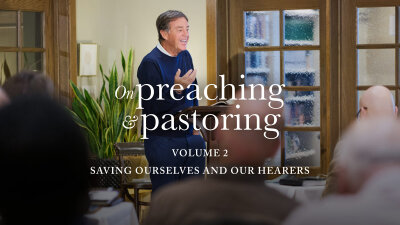
On Preaching and Pastoring, Volume 2
Saving Ourselves and Our Hearers 1 Timothy 4:1–16 Series • ID: 29022Sermon Transcript: Print
I want just to quote from my old boss, Derek Prime. He says,
In the history of the church throughout the centuries, God has clearly prompted his people, and pastors and teachers in particular, to come together to deepen their fellowship in the gospel and to stimulate one another in faithfulness to it. Those who gathered in the Eclectic Society at the end of the eighteenth century under John Newton’s leadership little knew how significant it was to be.
They all came together by invitation, and, I guess happily so, they had no concept at that time of what would flow from that. And without trying to overstate these things, it is, I guess, our hope and prayer that as we gather as fellow foot soldiers, not only in the immediacy of the moment but with an eye to the future, that somehow, in the goodness of God, there will be those who will look back and say those few times that they were together were meaningful to them. And I come to it in that expectation.
I went through all your names, some of them pronounceable, and others—others look like they’re missing consonants. There’s a fellow here called Op. And I said, “Are you missing a consonant, or what’s going on?” He said, “No. I’m German.” I said, “Okay. That’s fine.” But…
So, the preponderance is here from Ohio, which makes sense. Georgia is represented, Indiana, California, Virginia, Pennsylvania, Ontario—because we’re thinking of North America, the continent, not simply the United States of America—Ontario, and Florida, and Maryland, and Minnesota, and Michigan, and—Kentucky! (I can’t read my own writing.) Is there a state or a place that I missed? Okay. Nobody’s here from Arkansas, right? That’s good. All right.
All right. Somewhat arbitrarily, because we had to decide on something, we decided that we would take 1 Timothy 4 as our framework for today. And so, let me read the passage for the day, and then we’ll turn to this opening section. So this is Paul to Timothy:
“Now the Spirit expressly says that in later times some will depart from the faith by devoting themselves to deceitful spirits and teachings of demons, through the insincerity of liars whose consciences are seared, who forbid marriage and require abstinence from foods that God created to be received with thanksgiving by those who believe and know the truth. For everything created by God is good, and nothing is to be rejected if it is received with thanksgiving, for it is made holy by the word of God and prayer.
“If you put these things before the brothers, you will be a good servant of Christ Jesus, being trained in the words of the faith and of the good doctrine that you have followed. Have nothing to do with irreverent, silly myths. Rather train yourself for godliness; for while bodily training is of some value, godliness is of value in every way, as it holds promise for the present life and also for the life to come. The saying is trustworthy and deserv[es] … full acceptance. For to this end we toil and strive, because we have our hope set on the living God, who is the Savior of all people, especially of those who believe.
“Command and teach these things. Let no one despise you for your youth, but set the believers an example in speech, in conduct, in love, in faith, in purity. Until I come, devote yourself to the public reading of Scripture, to exhortation, to teaching. Do not neglect the gift you have, which was given you by prophecy when the council of elders laid their hands on you. Practice these things, immerse yourself in them, so that all may see your progress. Keep a close watch on yourself and on the teaching. Persist in this, for by so doing you will save both yourself and your hearers.”
And it really is that last verse which gave rise to today. When we had a conversation, I said, “Well, why don’t we consider what the Bible has to say about how we save ourselves?” And the person said, “But we can’t save ourselves.” I said, “Oh, yeah, we can, actually. You can find that in 1 Timothy 4:16.” But anyway, that was just a tease, and I just remembered something that I left in here.
Thank you for not leaving! All right.
Well, I just want to pause again just for a moment in prayer:
Father, take your truth; plant it deep in us. Shape and fashion us in the likeness of the Lord Jesus, we pray.[1] Amen.
So, the first five verses are our focus for now.
During the summer months, I traveled a little bit by car. And earlier, in a journey that I was making first of all down to Carolina and then to Tennessee and then back from Tennessee, I was encouraged by my children to make use of Waze. Most of you will know what this is; it’s a mechanism for establishing our direction in driving. And by repute, according to my kids at least, it’s much better than Google Maps or anything else. “Well,” I said, “fine. I’ll take your word for it.” And off I went.
How many of you have used Waze and do use Waze? All right, there we go.
I found it very, very helpful, but I wasn’t prepared for the voice prompt that tells you that there are hazards ahead. And I can’t tell you how many times when that lady said, “Watch out!” that I nearly drove my car right off the road. That’s like “Whoa! No!” And I’ve thought a lot about it, and I said, “I wonder: Am I the only person that reacts to that voice prompt in that way?”
So, what did I do? I looked online to see if others had had similar reactions. And that is actually the case. Some users, “find the ‘Watch out!’ too aggressive or anxiety-provoking and have suggested using something calming, like ‘Caution!’ or ‘Oops!’” Are you kidding? “Caution!” Yeah. No.
I begin in this way because I am tempted to believe that Paul, although he was not using the same transportation that we enjoy, if there had been a similar kind of opportunity to him as he moves around on his donkey from time to time, he would have been quite happy with the exhortation “Watch out!” Because he employs it himself, and Jesus employs it also. “Watch out,” says Jesus.[2] “Watch and pray,” says Jesus.[3] “Watch yourself; watch your doctrine. Watch!”
And so, in many ways, what you have here is a call to look out. And the context in which this call is set, as you can see, is that of apostasy and of people who are dabbling in dangerous doctrines. And so what Paul begins by doing is simply to point out to Timothy—and, indeed, to all the Timothys that follow him—that there are hazards ahead. Dangerous times, he says, are ahead.
Now, we know that Paul had seen them coming, because, you will remember, in Acts, when he takes his leave of the Ephesian elders, he issues that warning at that time: “You should be very careful. You should watch out, because after my departure, fierce wolves will come in. Among you there will be arising those who say twisted things and seek to draw people away after them.”[4] So he has already mentioned some who have rejected the “faith and a good conscience” and have subsequently “made shipwreck of their faith.”[5] So he’s not talking hypothetically. He’s already dealt with this. In chapter 1, in verse [20], he mentions Hymenaeus and Alexander as being illustrative of what happens when this kind of teaching begins to embed itself.
What Will Happen
And so, he begins, then, by saying that Timothy and we must be prepared to meet the apostasy that is foretold by the Spirit. It is foretold by the Spirit. God’s Spirit specifically tells us that in later times, there would be those who abandon the faith. That’s how he begins. It’s there in the text.
Now, we could pause here, if we were in a Bible study context, and ponder with one another just exactly how this came about. It is by way of revelation, obviously, that it is the Spirit of God that is the authority in making this statement and that Paul himself is the voice piece, if you like, telling those who are under the tutelage of Timothy what they can expect.
Now, the little phrase there, “later times,” is actually different from “in the last days,”[6] which you have in 2 Timothy 3. I don’t think it’s a significant difference, but it’s worth pointing out. It is true what he says to Timothy: that in the last days there will be this massive declension. But here, he’s actually talking about the fact that just as there have already been these times (hence Hymenaeus and Alexander), in these later times, “there will be times later on when you, Timothy, are going to encounter this kind of thing.” And he knows this because the Spirit has made it known to him.
It is not information that Timothy doesn’t need. You will notice that “the Spirit … says…” It’s in the present tense—that what the Spirit is saying to the church—you have the exact same thing, for example, in Revelation[7]—that it is always up to date, and it is always relevant; that it has immediate application to the context in which Timothy is ministering, which is why he mentions it; and it is also going to be of relevance to the congregation, who will presumably—or the congregations, better—who will be the recipients of the letter, insofar as, although it is a personal letter to Timothy, it would have a public disclosure so that the congregations themselves would be learning these things along with Timothy.
How It Will Happen
Now, not only does he tell Timothy and tell us what will happen, but he then tells us how it will happen. How it will happen. And the departure from the faith will happen on account of those who devote themselves to deceitful spirits and teachings of demons.
Now, this may sound overdramatic, but it’s not. And you will notice it says “some.” “Some.” Something always begins with “some.” “Some.” You have the exact same thing, for example, when Jude writes. And he doesn’t use the word some, but he uses the phrase “certain persons.”[8] “Certain persons”—doesn’t name them, but he identifies them by the things they’re teaching and by the character of their lives. And Paul is doing very much the same thing here. These individuals, he says, have allowed themselves to be spiritually seduced by the teaching of demons. It’s not doctrines about demons; it is the doctrine of demons. In other words, the source is demonic. Demonic.
Now, you say, “Well, it must be quite remarkable to live in a world like that.” Yeah, we are living in a world like that. Ephesians 6, Paul makes it very clear that we’re not wrestling against flesh and blood but against spiritual wickedness, about the spiritual powers of darkness[9]—that Satan is the great deceiver. He is by nature “the father of lies,”[10] and he seeks to lead people astray, “if possible, even the elect”—Matthew 24:24. And the Evil One’s tools are his victims. They are the victims of having been seduced by the stuff that he promulgates.
This, of course, raises the whole question of the devil, doesn’t it? (And that was what I left in here. I left the devil in my thing in there. You should keep him as far from you as you possibly can.) But this is an old poem that I’ve had for a long time. And, you know, I’ve lived long enough to have lived through the Peretti years (remember Piercing the Darkness?), in which he sounded a very important note, didn’t he, about these very things? Maybe a little overplayed, in that the people who really took it on board managed to see demons everywhere. It’s “Oh! There’s one right there on your shoulder”—that kind of thing. So they became so possessed with the thought of demons that they could hardly think about nothing else. The devil loves it when either we ignore him completely or we’re preoccupied with him entirely. And the balance is in being able to address these things, as Paul does here, with a sense of propriety and clarity and brevity, I suppose.
But this poem is entitled “Who Does the Mischief?” And it goes like this. It’s not brilliant poetry, but the point is fair:
Men don’t believe in a devil now as their fathers used to do;
They’ve forced the door of the broadest creed to let his majesty through.
There isn’t a print of his cloven hoof or a fiery dart from his bow
To be found in earth or air today, for the world has voted it so.But who is mixing the fatal draught that praises heart and brain
And loads the earth of each passing year with ten hundred thousand slain?
Who blights the bloom of the land today with the fiery breath of hell?
If the devil isn’t, and never was, won’t somebody rise and tell?Who dogs the steps of the toiling saint and digs the pits for his feet?
Who sows the tares in the field of time wherever God sows wheat?
The devil is voted not to be, and of course the thing is true;
But who is doing the kind of work the devil alone should do?We’re told he doesn’t go about as a roaring lion now;
But whom shall be held responsible for the everlasting row
To be heard in home, in church, and state to the earth’s remotest bound,
If the devil, by a unanimous vote, is nowhere to be found?Won’t somebody step to the front forthwith and make his bow and show
How the frauds and the crimes of the day spring up? For surely we want to know.
The devil was fairly voted out, and of course the devil is gone;
But simple folk would like to know who carries his business on.[11]
And part of the challenge, I think, in living in our very techno-savvy world is to be able to give voice to this kind of thing without being regarded as just a complete loony, right? Because the shift in the view of the world in terms of light and darkness, in terms of truth and error, in terms of heaven and hell has shifted dramatically, even in the space of some of you who are young. And so we have to take seriously the exhortation that is given here to Timothy: “Watch out!”
I suggest it is the ultimate naivete to assume, if we’re tempted to, that the false doctrines and spurious teachings are manageable simply by our arguments and our refutations—in other words, that we can argue this out; we can simply show that this is not the case. J. B. Phillips says, paraphrasing our text, “We are up against the unseen power that controls this dark world, and spiritual agents from the very headquarters of evil.”[12] “From the very headquarters of evil.”
It’s an old chestnut for me now, but I remember one of my friends that I was at college with in London visiting a hospital when he was in Leicester in the early days of ministry. And he’d gone into a long ward, and the people were in beds along the ward. And as he’d gone through to see one of his parishioners, he found somebody else that was sitting up in bed in a posture of prayer. And so he went to the person and said, “Excuse me. I could see you were praying. Are you a Christian?” And the person said, “No, I’m a Satanist, and I’m praying for the destruction of Christian families.” That was what he said. Well, it was very bold, wasn’t it? And also very clear.
By Whom It Will Happen
He tells what will happen. He tells us how it’s going to happen—how this departure from the faith will take place by those who are devoting themselves to deceitful spirits and the teaching of demons. But this is not going to happen in a vacuum, he says. It’s not going to just drop down from the sky. It is going to be promulgated—notice the phraseology—“through the insincerity of liars.” “Through the insincerity of liars.”
And what he’s doing here is he’s identifying the character of the people whom Timothy will encounter along the way that will be the ones who are conveying this kind of stuff. The demonic doctrine is not the work of hypothetical liars but actually peculiar and particular liars.
We might ponder—I wonder, is it right for us to ponder… I was just thinking of this as I speak. We might ponder the application of this to what James says in his epistle in chapter 3. You’ll want to just check that it’s actually there. Yeah, 3:13. I’ve never really thought about what we’re discovering here in 1 Timothy 4 in relationship to this, but I just throw it out there as worthy of pondering. James 3:13: “Who is wise and understanding among you?” Notice the very saying: “By his good conduct…” It doesn’t actually go to “by his education.” “By his good conduct let him show his works in the meekness of wisdom. But if you have bitter jealousy and selfish ambition in your hearts, do[n’t] boast and be false to the truth.” Why not? Because “this is not the wisdom that comes down from above, but is earthly, unspiritual, demonic. For where jealousy and selfish ambition exist, there will be disorder and every vile practice.”
It is the ultimate naivete to assume that false doctrines and spurious teachings are manageable simply by our arguments and our refutations.
So, the immediate relevance of it is actually quite staggering, isn’t it? Jealousy and selfish ambition is essentially Satan-driven and gives rise to “disorder” and to “every vile practice.”
Again, you see that in terms of Jude, where those “certain persons” have crept in, and the correlation between the falseness of their teaching and the immorality of their lives is unquestionable: “Certain people have crept in unnoticed who long ago were designated for this condemnation, ungodly people, who pervert the grace of our God into sensuality and deny our only Master and Lord, Jesus Christ.”[13] It’s very salutary, isn’t it? It’s quite a warning.
Now, what he goes on to point out—and we’re still here in 1 Timothy 4, I hope—is that he goes on to point out that there’s no point in appealing to the consciences of these people: “through the insincerity of liars whose consciences are seared.” In other words, their consciences have been cauterized, and therefore, they’ve lost all sensitivity to falsehood and, in turn, to a lifestyle that is the evidence of false thinking. They’ve been rendered insensitive to right and wrong as a result of a continuous diet of sin and deception. It really is staggering to ponder this.
The American Indians, I think it was I heard, would describe conscience as a triangle that was in the solar plexus of the individual and that when they violated their code of ethics or whatever their view was, then the triangle would turn within their tummy, as it were—it’s just a metaphor—and would jag them until they became so adept at sinning and ignoring the ethics that it changed from a triangle to a circle, because they had just worn the corners down that once prompted them to action or to repentance.
I think it’s an interesting picture, but I think it’s good. It’s good for us to say to ourselves, first of all, “Well, does it jag you anymore? Or have you grown accustomed to it?” Have I begun to allow myself to say, “Well, you know, jealousy’s not that big of a deal”? It’s a huge deal. In many ways, a gathering like this is prime territory for the jealousy test. It is, in all honesty! And it is a snare.
“And so, Timothy, here you have it. The Spirit expressly says this is what’s going to happen: They will depart from the faith. They will do this by devoting themselves to deceitful spirits, the teaching of demons. This won’t come in a vacuum but through the insincerity of liars whose consciences are seared.”
What They’ll Be Teaching
And then, fascinatingly, he says, “And this is the kind of thing that they’re going to be teaching.” Now, I don’t know about you, but it seems to me that I might have expected something a little different from this, right? Like, because, wow! I mean, verses 1 and 2, they’re heavy-duty! You know, “deceitful spirits,” “teachings of demons,” insincere liars—seared consciences who “forbid marriage.” Wow! Is that such a big deal? Well, yeah, it was. It was a huge deal. They “forbid marriage,” and they “require abstinence from foods that God created to be received with thanksgiving by those who believe and know the truth.”
Now, at the very heart of this is the doctrine of creation: that God has created both the world and the provision that is made for us in living in the world and, at the very center of that, has provided marriage in the context of the replenishment of the earth and so on. And so, therefore, for somebody to take that on at that level is essentially to seek to subvert the creative plan and order of God. That’s really what’s going on: that God says, “This is how it is to be,” and these people are saying, “No, this is not how it is to be”; that God says, “You should approach every provision from my hand with a spirit of thankfulness,” and they say, “No, that’s not the case at all. In fact, we’re going to abstain from these things.”
Now, it’s worthy of consideration whether we want to develop the notion that marriage as opposed by the Roman Catholic Church is the ultimate expression of this or not. I think there is a fair basis for why the Reformers, when they were teaching this passage, were very clear about that. Lenski, the Lutheran commentator, of course, whom you would expect to be on the side of Luther in these things, says of this matter—and he’s writing in the twentieth century—this “still flourishes” in “the … monastic system that developed, … with all the lying teachings” that accompanied it.[14] That’s pretty straightforward. But that was Lenski; it wasn’t me—although I think he was really good on that, so there you have it.
The underlying notion, I think, is that by abstaining from these outward things, then one might be able to attain to a higher level of spiritual perfection. Now, that may not be all that is there, but it surely is in part. God created both, and to forbid either is to challenge his creative work. And the reason that Paul forcefully opposes this is on account of the dangerous implications that flow from it. When you take, for example, the nature of marriage itself—and we can come back to this as we follow on in the verses that follow—when you think about the nature of marriage itself being opposed and all that flows out from that, you can see why, in the context of Timothy’s day, Paul was so concerned about it.
It is vitally important that they understand that God is the creator God and that he is the one who has ordered things according to his plan and his purpose. That’s verse 4: “For everything created by God is good.” In the beginning God created the heavens and the earth. And he looked on all that he had made, and he said, “It is good.”[15] And for anybody to say, “No, that’s not the way it should be,” is to oppose God.
“Nothing [should] be rejected if it is received with thanksgiving …, [because] it[’s] made holy by the word of God and prayer.” That phraseology is challenging in itself. I wonder how you would like to teach that. In fact, I might ask your help in it before we finish this up. But it seems to me that the Word of God is the way in which God speaks to us, and prayer is the way in which we respond to God—and so that we receive all that God has given us as described for us in the Word of God, and we then come to God in the awareness that he made us, that he sustains us, that he provides for us.
But the people were coming into the context of Timothy’s environment to say, “No, we’re not going with that program at all. We have another plan altogether.” And so, if you like, you can see how the kind of gnostic notions then began to take root in the church. So, a form of asceticism was regarded as being the real primacy of holy living—that we would be identified by all the things that we didn’t do, and we could always add another list to suit our own satisfaction.
The Word of God is the way in which God speaks to us, and prayer is the way in which we respond to God.
By the time Paul gets to chapter 6 of this, it’s clear that he’s warning against not only the notion of asceticism, where we deprive ourselves of things, but I think we’d have to agree that in verse 9 of chapter 6, he’s warning against, if you like, consumerism—not asceticism on the one hand or consumerism on the other: “But those who desire to be rich fall into temptation,” and “into a snare, into many senseless and harmful desires that plunge people into ruin …. For the love of money is a root of all kinds of evils. It is through this craving that some have wandered … from the faith and pierced themselves with many pangs.”
So in other words, the Evil One has got plenty of strings to his bow. He can either distract and distort along the line of what we’re not getting, or he can convince us that it is by the accumulation of all these things that we will be able to make sense of our lives. And Paul warns against them both, because it is God who gives us all things richly to enjoy[16]—so that marriage and daily food are then sanctified by the means of God’s Word and of prayer; so that, as he says when he writes elsewhere, so that whatever you do, you may do all to the glory of God.[17]
Now, I think I’m just going to stop there, because I can talk on for a long time, but it’s not necessarily very helpful. And I don’t want to intrude into the next section, because then there won’t be a next section for me. And so, let me just remind us of what we’ve tried to say—at least what I wrote on my notes—and see if you understood, that you could follow what I said.
That the concern is to be aware of the context: “Watch your surroundings. Look out. Watch out. Timothy, be prepared to meet the apostasy that is foretold by the Spirit. You need to know what to expect. Because God’s Spirit specifically tells us that in later times, this will happen—that people will abandon the faith.”
He then tells him how it will happen: the declension from the truth as a result of those who devote themselves to deceitful spirits and the teachings of demons. So, in other words, this is something very, very significant, something very, very dramatic. This is not because Mrs. Jenkins didn’t like your sermon last Tuesday, and you said, “Well, funnily enough, I just read about you in 1 Timothy 4. You’re coming in here with your deceitful spirit. Yeah, go make coffee, Jenkins, please.”
So, he tells us how it will happen, and then he tells us that this will be through the insincerity of liars. He then wants Timothy to be in no doubt concerning the kind of things they were saying—essentially tackling the very order and purpose and plan of God. And Paul explains that by contrast, those who believe and know the truth understand that he provides us all things richly to enjoy—in other words, that there is, if you’d like, a kind of sanity, a kind of happy balance that we learn in the company of one another.
Perhaps just one PS: this notion of those who abandon the faith. Because we come back to this, don’t we? The dreadful thought of apostasy. I made a note for myself some time ago, and I can just quote it for you here. Because I think I was in John 17 at the time, and thinking about being kept to the end,[18] and then saying, “Well, what do we do with Judas Iscariot? And how does that factor in? And what’s the difference between apostasy and backsliding, if you like?”
And I just made a note of this: that anyone who, after making profession of faith, returns wholeheartedly to sin—returns wholeheartedly to sin—renounces his former Christian allegiance, displays no remorse in doing so, and continues in this apostasy to the end of his life was surely, despite initial appearances, never actually truly born of God.
Now, we would never want to make that pronouncement, but we want to consider ourselves in relationship to these things. Some Christians stumble and fall. Some of us, as Christians, stumble and fall back a long way. But the difference is that the true believer knows it and even, if you like, in the far city, retains some degree of awareness of what they’ve left behind and has within them, however minimal, a longing to return.
And I think that’s probably where the difference lies. I mean, we could say, “Well, Peter made a hash of it”—which he did. He fell back a long way. It’s pretty heavy-duty. But there’s a distinction between Judas and Peter. Some of us pray very much for prodigals, don’t we? Some of us actually probably were prodigals. “But when he came to himself, he said…”[19] You see, the apostate never comes to himself. “When he came to himself, he said, ‘I will arise, and I will go back to my father, and I will say, “I’ve sinned against heaven and in your sight.”’” That’s a sign of genuine faith as well—that I know that I am a sinner. “‘“I’ve sinned against heaven and in your sight. I’m not actually worthy to be called your son. Make me as one of your hired servants.”’”[20] And the apostate says, “I don’t care. I frankly don’t care.” It’s a dreadful thought, isn’t it?
And so the warning that he issues is a practical warning. It’s a necessary warning. It’s a timely warning. “Watch out!”
Father, thank you for the Bible. Thank you for Paul. What an amazing thing that the person that you brought up to be the minister to the gentiles was the arch-opponent of Jesus and the followers of Jesus! And you gave him a new heart, and you gave him a discovery of the nature of mercy, and you gave him a love for those who love Jesus and for the church. And the letters that he wrote, that we are able to read, have been generated by the Spirit of God and kept as a result of the ongoing work of the Spirit so that we might be the beneficiaries, along with Timothy and all the other Timothys throughout the last two thousand years who have paid attention to the Bible and have said to one another, “Let’s watch out.” And we pray in Jesus’ name. Amen.[1] Stuart Townend and Keith Getty, “Speak, O Lord” (2005).
[2] Mark 8:15 (ESV).
[3] Matthew 26:41; Mark 14:38 (ESV).
[4] Acts 20:28–30 (paraphrased).
[5] 1 Timothy 1:19 (ESV).
[6] 2 Timothy 3:1 (ESV).
[7] See Revelation 2:7, 11, 17, 29; 3:6, 13, 22.
[8] Jude 4 (paraphrased).
[9] See Ephesians 6:12.
[10] John 8:44 (ESV).
[11] Alfred J. Hough, “Who Carries on the Business?” Paraphrased.
[12] Ephesians 6:12 (Phillips).
[13] Jude 4 (ESV).
[14] R. C. H. Lenski, The Interpretation of St. Paul’s Epistles to the Colossians, to the Thessalonians, to Timothy, to Titus and to Philemon (Columbus, OH: Wartburg, 1946), 623.
[15] See Genesis 1:1, 31.
[16] See 1 Timothy 6:17.
[17] See 1 Corinthians 10:31.
[18] See John 17:11–12.
[19] Luke 15:17 (ESV).
[20] Luke 15:17–19 (paraphrased).
Copyright © 2026, Alistair Begg. Used by permission. All rights reserved.
Unless otherwise indicated, all Scripture quotations for sermons preached on or after November 6, 2011 are taken from The ESV® Bible (The Holy Bible, English Standard Version®), copyright © 2001 by Crossway, a publishing ministry of Good News Publishers. Used by permission. All rights reserved.
For sermons preached before November 6, 2011, unless otherwise indicated, all Scripture quotations are taken from The Holy Bible, New International Version® (NIV®), copyright © 1973 1978 1984 by Biblica, Inc.TM Used by permission. All rights reserved worldwide.